
Anna Children (Anna Atkins)
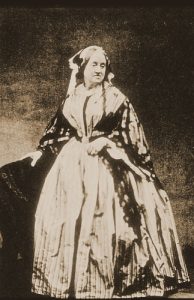
John George Children’s only child, Anna (1799-1871) was brought up by her father and grandfather in the lively family home at Ferox Hall. From her father, to whom she was particularly close, she gained practical skills and a love of science unusual in a woman at that time. She was a botanist and also an excellent illustrator who contributed more than 200 drawings to a book on shells which her father had translated from the French.
In 1825 she married John Pelly Atkins, who would later become Sheriff of Kent, and it is as Anna Atkins that she is best known – better known in fact than her father or grandfather. There were no children and Anna devoted much of her later life to photography, a field in which she is a notable pioneer.
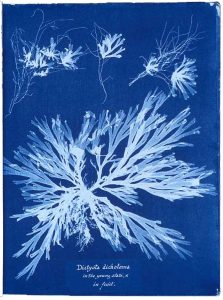
The Childrens were friendly with two other important figures in the history of photography, W. H. Fox Talbot and the astronomer John Herschel. Herschel devised a photographic technique known as the cyanotype process, in which paper was impregnated with a material which turned blue when exposed to light, producing what were later known as blueprints. Anna Atkins used this technique to create shadow images of botanical specimens, a pioneering application of photography to science. Over ten years she was personally responsible for the production of the more than 400 cyanotype plates needed for each copy of her book ‘Photographs of British Algae’, based on her own seaweed collection. This book was the first ever produced wholly by photographic means. The pictures in it are of artistic as well as scientific interest and some of them survive today in the collections of museums and galleries around the world.
One of Anna’s close friends was Anne Austen, a second cousin to Jane Austen, who lived with the Childrens as a child. In later years the two sometimes co-operated in producing cyanotypes of other natural objects, more for aesthetic than scientific purposes.
Anna died in 1871 at her home, Halstead Place, between Knockholt and Chelsfield in Kent,
and is commemorated there by a blue plaque.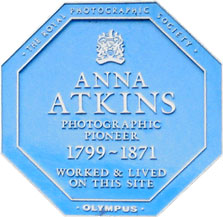
>You can read more about Anna Atkins’ photographic work on the Royal Photographic Society website.
The portraits and cyanotype on this page are out-of-copyright images from Wikimedia Commons.